THE DANCE by THE WEDDING PHOTOGRAPHER IN LISBON
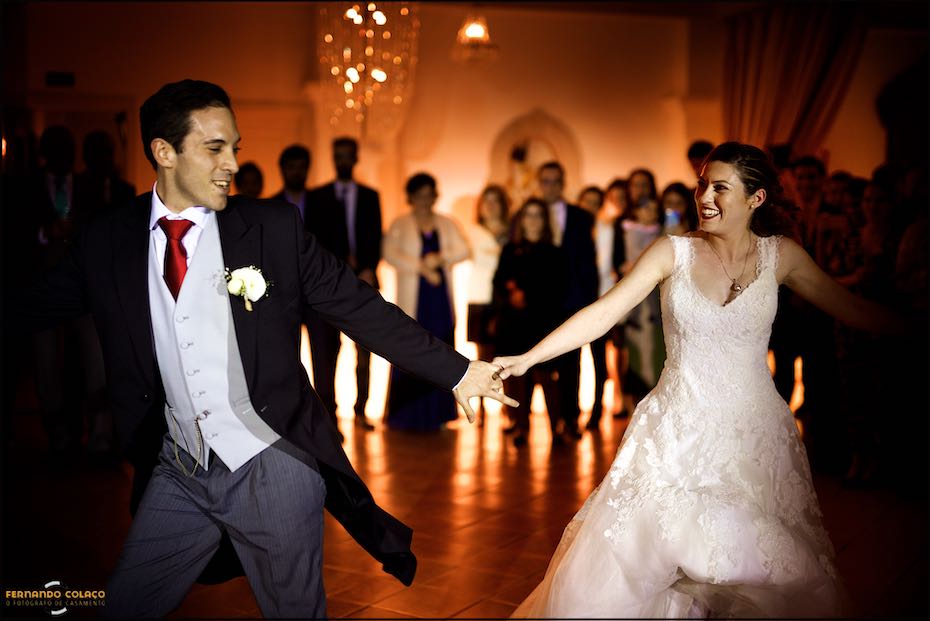
The photos are taken at Casa de Reguengos, in Vila Franca do Rosário, during the bride and groom’s first dance at the wedding party.
- Pode ler este artigo em Português.
Wedding photographer, around the dancing couple

If you think that, during a couple’s first dance on their wedding day, the happiness of the performance belongs only to them, you are mistaken. There is something there that goes far beyond the two of them, because that first movement across the dance floor is also a kind of signal given to everyone else.
It is there that they say, without needing to say anything, that from that moment on, it is music. Music at decibels that are hardly advisable for the ears, bodies full of energy stored at the dinner table and now ready to move, jump, spin, and endure all the rhythms coming from the DJ’s table.
And, in the middle of all this, there is the wedding photographer.
For him, another dance begins.
The photographer dances too
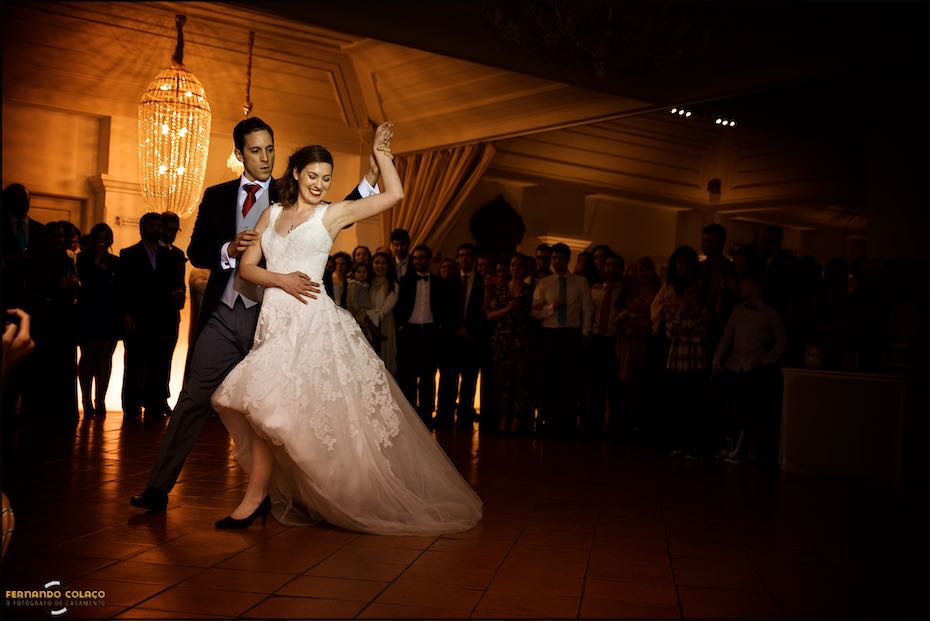
That is what happens because you have never seen the wedding photographer around that dancing couple, with one camera to his right eye and another over his shoulder, ready for a different angle.
If you had ever seen him, you might realise that they are not the only ones, the bride and groom, enjoying themselves under that shower of musical notes, in a binary or ternary rhythm, depending on what they chose to begin the night.
They are the best ones for dancing as a pair, they say.
And through that dance they also show all their guests that they are perfectly in harmony, as should happen between dance and music. One step calls for another, one turn brings a new position, one movement announces the next. And, for the person behind the camera, all of this leaves little clues.
The photographer follows them.
He does not dance exactly as they do. He dances around them.
He moves because they move. He stops because he realises that there is a photo to be made at that precise moment. He moves away to let them enter the frame and comes close again when he feels that something is about to happen.
The music, for him, becomes almost secondary.
Waiting for the photograph they are going to give him

That is perhaps the only difference between them, the dancing couple, and the wedding photographer around them.
For the couple, the music is everything.
For the photographer, the music may cease to exist.
Sometimes it really seems as though he stops hearing it. Their movement is enough to guide him. That is what motivates him and tells him where he needs to go.
He spins around them, suddenly stops, and lowers himself to the floor. He seems to jump and take several steps backwards. Then he runs gently, almost like a dancer in Swan Lake, trying to reach the other side of the stage in time to catch the ballerina.
Except here there is no stage.
There is a dance floor.
And there is a photograph that is about to happen.
He knows it will happen because he has already seen the movement begin. He knows it from the dance steps, from the rhythm, from the way the couple moves, and from many years of doing this.
Nobody needs to tell him where to go.
The lens also seems to know
Sometimes the photographer looks like one of those policemen from spy films, hiding very quietly and waiting.
He stays there, apparently doing nothing, as if he has disappeared for a moment.
But he is waiting for that photograph that they, the dancing bride and groom, are going to give him three steps later.
And when it appears, he gets it.
Then he jumps again.
His lens, which thinks it knows everything, is already telling him to go to the other side. And he knows he has to obey because, so far, it has never let him down.
It is a curious relationship between the photographer and his lens.
While the couple dances, he watches, follows, anticipates, and reacts. There are moments when he seems to know exactly where he should be, although, to someone watching from outside, everything may look like a succession of improvised movements.
Perhaps that is exactly what it is.
An improvised dance, but not completely.
Because there are things he already knows.
He knows that after that movement another one will come. He knows that, after a turn, the two of them may end up exactly where he wants them. He knows that moving closer may give him one photograph and that, immediately afterwards, he will have to move away so he does not lose the next one.
And he continues.
Another dance made to capture wedding photographs
As you can see, happiness also takes the wedding photographer into improvised choreographies. But these are choreographies directed by the true dancers of the night. The bride and groom do not give him a single instruction.
They do not need to.
Through their dance, they are the ones who harmonise perfectly with his. And the photographer follows, accompanies, anticipates, and allows himself to be guided by their movements.
There is something beautiful about that. They think they are simply dancing. He knows that he is also photographing a dance that exists only at that moment and in that particular way.
He cannot ask them to do it again.
He cannot say: now do that movement again because the photograph did not turn out as I wanted. The photograph happens there. And, if he manages to catch it, it stays.
If he does not, it is gone.
That is why all that movement around the couple also carries a kind of urgency. Not an urgency that can be seen, because he does not want to interrupt anything, but an urgency made of permanent attention.
Invisible, as he likes to think he is
However, he thinks nobody ever saw his performance.
As has already been written here many times, he has this idea that he is invisible.
And that is why he throws himself into so many steps of another dance, one made more to capture wedding photographs than loving looks.
Those belong to the people being photographed. As they should. The couple is the one that should appear.
The photographer may be running, stepping backwards, crouching, spinning, or disappearing into a corner of the dance floor. He may be changing cameras or looking for another position. He may be making a photograph almost at floor level or looking for a different view from higher up.
In the end, none of that should remain in the photographs.
What should remain is their dance.
Their moment.
That first dance that opened the floor and, from then on, handed the party over to everyone else.
And perhaps that is the funny part of this other dance: the photographer does everything so that nobody notices that he was dancing too.
Point by point
- When the dance begins at the wedding reception, it is not only the bride and groom who dance to open the party. The wedding photographer performs his own dance around them too.
- The key difference between him and the bride and groom is that he follows their movements rather than the music, and he seems to stop hearing it because he’s so focused on the couple.
- At times, he seems still, but he is simply waiting for the photograph he knows the couple is about to give him.
- When that photograph appears, he changes position again and begins another search.
- Of course, with his idea that he is invisible when photographing, nobody saw him and only the couple shone.
You need to know
The photographs featured in this article were taken at Casa de Reguengos, in Vila Franca do Rosário, Mafra, during the first dance that opened the wedding reception.
It is precisely in moments like these that I realise that photographing a wedding can also be a kind of dance. Not one that is learned, nor one that is rehearsed, but one that is born from observation and from what the people being photographed are doing in front of us.
Conclusion:
The first dance belongs to the couple, but while they dance, another dance is taking place around them. The photographer follows them without asking anything, simply trying to be in the right place when the photograph appears.
Perhaps that is the best way to explain this small choreography: they dance to live the moment, and the photographer dances to preserve it.
The photographer for your first dance
If you are imagining your first dance and would like someone to follow all those movements while you live that moment, without interfering, that is exactly where my work comes in.
Being close when necessary, stepping back when the photograph needs space, and letting you be the ones to lead the entire dance.