
TAILORING PHOTOS by THE WEDDING PHOTOGRAPHER IN PORTUGAL

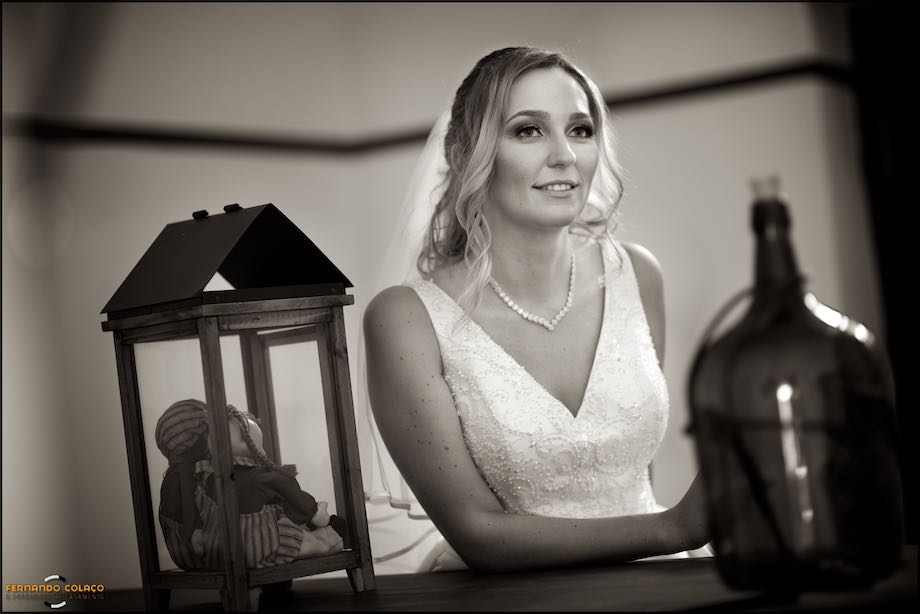
Photo of the groom adjusting his grin in the mirror and the bride ready, between two objects, for the wedding ceremony at Quinta do Castro in Cadaval
• Pode ler este artigo em Português.
The wedding photographer and the making use of the spaces they shoot in
A wedding photographer, unlike what many believe, is not just someone who captures images.
They are a visual storyteller who transforms ordinary settings into memorable frames, capturing the essence of one of the most meaningful days of a couple’s life — the wedding day.
In this creative process, making use of what already exists in the locations where the ceremony, preparations, or celebrations take place is not just a strategy; it’s an essential art form.
The importance of using what the space provides
Every time a wedding photographer steps into a new venue — whether a classic hall, a family home, or a modern hotel — they encounter a new set of challenges and opportunities.
Each space is a stage with potential, and each object within it can become an additional character in the visual narrative of the wedding photographs.
Starting points for a unique visual narrative
- Existing decorative elements:
- Antique or modern lamps
- Vases with fresh or dried flowers
- Curtains, mirrors, and wall textures
- Chairs, tables, or sofas with character
- People behind the scenes:
- Hair and makeup artists at work
- Family members of the bride and groom in quiet moments
- Wedding guests are moving around casually
A wedding photographer transforms these seemingly ordinary elements into key parts that bring dimension to the wedding photography. They are not just backdrops — they’re natural frames, unexpected reflections, and points of interest that enrich the composition.
The role of mirrors in wedding photography
I’ve previously spoken about my near-obsession with mirrors. That obsession continues. Mirrors — round, square, big, or small — are true allies in creating visual depth.
They allow us to include off-frame elements, double scenes, or introduce subtle angles that enhance the final result.
Why are mirrors indispensable?
- They create depth and dimension
- Allow simultaneous front and back capture of a scene
- Introduce unexpected elements that surprise the viewer
- Help to tell more with fewer images
On the wedding day, a well-used mirror can be as expressive as a photo of a hug. It’s an invisible tool that gives voice to the silence of the walls.
A trained eye before the bride and groom arrive
Even before the bride and groom are in the frame, my eyes scan the space. My creative process always begins by identifying the elements I will use to “dress” the photographs. Not out of habit, but because each place is unique and demands a tailored approach.
Items I immediately look for upon arrival:
- Natural light: windows, open doors, skylights
- Reflective surfaces: mirrors, glass, metal
- Textures: aged wood, fabrics, tiles
- Spontaneous compositions: a misplaced chair, a forgotten glass, a fallen flower
The photographer as an image tailor
Being a wedding photographer is not just about taking pictures. It also requires being an “image tailor.” Just like a tailor selects the right fabric and sculpts each piece to fit perfectly, I choose each frame, each angle, and each object with purpose.
I want each photo to have shape, texture, and movement. And for that, I need to stitch elements together, even if they seem unrelated at first. That’s how I ensure every page of the wedding album has soul, not just style.
Context and setting: essential ingredients
For a story — written, filmed, or photographed — to be memorable, it needs context. And that’s exactly what I search for upon arrival at any venue on the wedding day. Without context, images lose impact and become generic.
Elements that provide this context:
- The where: the physical location, with its unique character
- The how: lighting, furniture placement, and personal objects
- The who: the protagonists (bride, groom) and supporting actors (family and guests)
These ingredients allow me to build a rich narrative with a clear beginning, middle, and end. A cohesive visual story where each photo is not just a record, but an emotional memory.
Conclusion:
Being a wedding photographer means being a sensitive observer who turns what’s already in a space into art. It’s about seeing the ordinary through the eyes of a creator, anticipating moments, and finding meaning in the subtlest of details.
Making use of the venue is more than a technique — it’s a philosophy that defines the difference between a common photo and one with real storytelling.
Book a meeting with me
Your wedding day deserves to be told with sensitivity, detail, and creativity. If you’re looking for a wedding photographer who turns spaces and objects into meaningful imagery, let’s schedule a meeting.
- In Quinta do Castro In Cadaval, near Lisbon, Portugal